Sunday, January 28, 2007

Kristian Burford & Marcel Duchamp

2 male artists of differnt art historical eras conversate in their interest in narrative, spectacle, and fantasy:


Kristin Burford's "Rebecca" is shown at I-20 gallery, a theatrical setting enclosed behind doors that is peekable through a small crack. I tried to open it further but it was glued to be a non-functional stationary door. As the viewer/peeker I was presented with an amorous scene that had nothing really to do with a sexual encounter as it seemed but a display of a paralyzed woman role-playing with 2 girls not present in the scene who dressed up Rebecca as a ballerina. The indifference of her body, her imminent complacence is as idle and sexual as Duchamp's victim wax figure in "Etant Donnes" but lacks the violence and mystery that Duchamp instills into his similar installation.

Thursday, January 25, 2007

Hey,Hot Shot! at Jen Bekman


jen bekman's "Hey, Hot Shot!" winter annual show opened wednesday night and what a delicious treat it was indeed. I've discovered a delightful and gratifying amount of information about what jen bekman does and how this show came about. If I am correct, she has a website heyhotshot.com where photographers can submit their work and participate in a competition which leads to seasonal exhibitions which then leads to those photographers being represented by the gallery.
There is an abundance of great work from past hey,hot shot! shows such as Dylan Chatain's exploratory photographs of people and their surroundings, pictures he must have taken while traveling around the country. They seem to comment on spontaneous and curious encounters with hidden natural beauties embedded in obscure locations where garbage, McDonalds, and people abound. It's a complacent mixture of poverty, idleness, sunlight, greenery (images of country), and claustrophobia (images of people in elevators). I found an aesthetic voice in each picture that was reflective and innocent, that each picture was as pure and literal, what you see is what you see. Here are some images:


In the current show there didn't seem to be a unifying theme, a little about massive consumption of objects and information found in the works by kate bingaman-burt, whose statement explains it all:

statement :: obsessive consumption
I documented my purchases for 28 months. Every purchased item was photographed at the point of sale or soon after. Every receipt was archived and tagged. All of the documentation was uploaded to my website obsessiveconsumption.com. I created a brand out of the process to package and promote - an infinite loop of consumerism was born.
In September 2004, I started collecting all of my credit card statements each month (six total) and am copying all of them in pen and ink every month until they are paid off. I have drawn 144 statements as of October 2006. I do this as penance for my sins.
In February 2006, I started drawing one item that I purchased everyday. I have no plans to stop.
I created Obsessive Consumption, the brand, the company and the website, to showcase my love/hate relationship with money, shopping, branding, credit cards, celebrity, advertising and marketing. Personal consumer spending and monthly credit card statements ferociously fuel my work.
Obsessive Consumption is about making the mundane special. I am taking a mass produced product and personalizing it. The consumer is no longer faceless.
Obsessive Consumption conforms to the cliché that shopping is a favorite past time of society. Obsessive Consumption is repulsed and grossly fascinated by the branding of consumer culture. It wants to eat the entire bag of candy and enjoy the sickness that it feels and hour later. It doesn't want to be an outside critical observer. It wants to be an active participant. Obsessive Consumption wants to be serious. Obsessive Consumption wants to have fun. Obsessive Consumption wants to document and create from experiences through this over stimulating, nauseating world of consumer culture.
CONSUME/DOCUMENT/MAKE
Obsessive Consumption was created to showcase my love/hate relationship with money, shopping, branding, credit cards, celebrity, advertising and marketing. The work is inspired by the ever ubiquitous, generic, delicate, sometimes stomachache inducing credit card statement, craft as activism, and general consumerism.

I find myself suffering all the time with this need to consume as much information as I can and to take that information and turn it into something productive such as posting on this blog. So in this sense, I obsessively connect with kate and I adore her over-productively in multiple channels of expression. Here's an example of her credit card bill drawing. how exquisite:

Monday, January 8, 2007

Material for the Making at Elizabeth Dee


Group show at Elizabeth Dee curated by new director Jenny Moore include works compiled together based on the theme of memory and subjective reality, re-presentation and re-making of things and memories that have already occurred and existed before.
Strongest work is Shaving Cream Series, a strip of small Polaroid photographs mounted horizontally by Gail Thacker, which includes images of performance artist Rafael Sanchez covered in shaving cream frolicking around with a swimming ducky float around his waist and a hat adorned with what seems to be a wired sculpture resembling baby toys that hang over a baby crib and rotate as it plays music and lulls the baby to sleep. It seems to recall psychoanalytical references of oedipal desires, fear of circumcision (the body lathered in shaving cream preparing to be razored), objects of infantile dependence such as the float and the crib toy. Gail Thacker manipulated the surface of the photographic material, rematerializing and texturing it through a "curing" process which makes it hazy and out of focus, much like our memories that are never truly rendered to the detail of its actuality.
In the back room is Kerry Tribe's video Near Miss, a recreation of an actual incident where her car spins on the highway in the middle of a snowstorm. I did not realize it was a set up recording until I came back into the main room and there was a photograph of the production process, the car mounted on top of a platform with a snow making machine and bright lighting. The video stirs the urgency and anticipation of an accident with the steady rhythm of the windshield wipers, as if to negate and comfort the anxiety of the viewer. In the end the car makes a slow, barely noticeable spin.
Kori Newkirk is well known for his use of pomade (a waxy hair gel) in paintings and other mediums. With themes of race and the transience of a short lived life he creates cut out snowflakes pasted around the gallery, scattered in different sizes but all in the same color black, against the white wall, seeming to hint at race differences between white and black. It reminded me of the appropriation of meaning Masaru Emoto gives to his snowflakes be exposing them to human conditions and emotional verbage.
Weakest work IMO was Mai Braun’s sculptures made of materials that have been deconstructed and reproduced to become an artistic object molded by the hands of the artist. A formless pastel yellow blob sits on a pedestal, an oversized textured snot meant to be abstract and unique in its “creating a symbiotic relationship between the image that inspired it and the form that follows after”. It is interesting that she has used found objects and gave them a new life as non-functional commodities but the lack of substance in the resulting form was tasteless and mute.

Saturday, January 6, 2007

More Highlights on Dia

Some more reflections on my recent visit to Dia:Beacon…
There was the general theme of geometric abstractions, of calculated and crispy clean shapes with a limited outsource of energy minus John Chamberlain’s contorted automobile parts, which were nothing but streaming color and vigorous movement.

The most mind-boggling works must be Sol Lewitt’s Drawing Series… , composed of 14 large wall drawings executed by a dozen or so assistants working on location at Dia. These obsessive and deliberate works reflect the Conceptual artists’ notion of executing an idea or concept onto a tangible surface. Squares and lines create gridded patterns on the wall arranged in colors limited to graphite and primary shades of red blue and yellow. They are at once visually engulfing, with viewer (me) hypnotized by the realization of a simple idea made existent in a serial manner. The determination to create these grids were rubbed off onto me and I am considering creating the same works with the guide of Lewitt’s instructions. That was his point, that it’s not the wall you take home but the conceptual idea he created. The drawings are merely the documentary evidence of Lewitt’s idea reduced to a written set of instructions, realized recently from concepts created in the 60’s.

Dia has exhibited extensively on Agnes Martin’s minimal stripe paintings in here they stood out as most gentle and feminine, differentiating from other geometric works such as Blinky Palermo and Robert Ryman. Large squares and horizontal grids were colored by soft pastels, barely significant lines drawn with graphite, serene and ephemeral in execution. I wonder why the initial graphite sketch weren’t erased one she painted over with these light colors, creating a second dimension of textured canvas and creating a music paper rendition of painting. Colors were neutral and peaceful creating a very subdued and almost ambivalent environment but simultaneously expressionistic. The delicate and painterly compositions creates a meditative and emotional environment distancing itself from the cold and rigid and mechanical works of fellow Abstract Expressionists and Minimalists.

Blinky Palermo’s series of mechanical abstract paintings titled To The People of New York City is composed of 39 individual paintings in varying sizes divided into 15 parts painted on aluminum panels and disposed onto the wall in calculated arrangement and placement. Colors were limited to red yellow and black arrangement in horizontal 3 part grids, usually 4 in a row in various combinations with equal distancing between them. They were repetitive and serial and captivating for this reason, the effect of the banal, the everyday experience of wake, work, eat, sleep expressed in this dedication as referred to the title. There is no gestural activity except but the slight slip of paint upon close observation between 2 colors, otherize a regularized and inflexible system occurs that is mechanical and inexpressive, reminiscent of a flag of some nonexistent country.

Gerhard Richter’s installation was comprised of large glass surfaces mounted and angled from the wall at various angles, all a consistent opaque gray, reflecting the surrounding environment but simultaneously silencing what enters the medium. There are 6 large panes in total intimidatingly surrounding the viewer in unison and consistency. Light from the ceiling window was reflected off the surface casting looming shadows and brightening with crystal focus on other parts. It is an example of the artist’s notion of painting as either a window to reality or a mirror reflection of the self. There is no sign of expression of pictorial language in and of itself and engages only with the viewer and its immediate surrounding. A contradiction between opacity and reflection, Richter’s Six Gray Mirrors offer no definite conclusion as to whether we should or shouldn’t regard these pieces as a window to a view of the world or as a mirror reflecting the self-conscious presence of whatever subject engaged with the artwork itself.

Fred Sandback’s signature use of string as art and the framing of non-space, negative space is displayed here in a rather hectic arrangement, scattered between multiple galleries, attacking the walls, floors and ceilings in a hap hazardous manner. Sandback created an environment of volume-less sculpture, space less and yet full of content based on perspective and concept. The outcome is in his words a “material relationship with my environment…part of a continuing attitude and relationship to things…” , here being the work in active participation with the space and viewer. It brings to mind of concept of sculpture as installation, no longer standing on a pedestal self-imposed and irrelevant to the space it is surrounded in. Here it is no participatory and shares the same space as the spectator.

Richard Serra’s Torqued Ellipses consists of a series of gigantic steel plates lined next to each other willowing from side to side like flowers against the wind. Each shape has a narrow entrance for the viewer to step in and experience the space within the piece, and become one with the art, experiencing a push-pull relationship to the winding of the steel plate. It’s an adventurous task and certainly claustrophobic, especially once reaching the center of the piece and you realize you’re in the center of a huge contained circular sculpture. Scary. This self-consciousness and hypersensitive awareness of the viewer’s placement within the sculptures gives Richard Serra the ability to engage what in his words are “ways of relating movement to material and space”.
There were many men artists represented in this exhibition. The only female artists would be Agnes Martin and Louis Bourgeois, the latter of whom was situated in an upstairs attic-like area and works that did not communicated with the overall minimal geometric abstract theme of the works downstairs. Overall the show questions the relationship and interaction between consciousness and space, between viewer and artwork and their awareness with the space and environment surrounding them. The messages are subtle and subdued, beautifully abstract and minimal, cool and calculated, theoretical and simultaneously simple. A splendid show and a peaceful perfect one day getaway upstate.

Tuesday, December 19, 2006

Dia artist of the day: Walter de Maria


Recently I’ve had the opportunity to visit Dia: Beacon twice in one month. It was a most serene and contemplative experience, a much needed relief from the labyrinth that is the New York art scene, or the chaos that is city life in general. A quaint and delightfully lit space, the museum was refreshingly open and void of clutter, crowd, and conundrum. It contained an assortment of minimal and abstract artists active in the 60’s and 70’s creating a unified stream of objects in varying mediums, giving the overall exhibition a simple, calculated and contained theme that was very much clear and straightforward.
Upon entrance I was greeted by a massive floor installation of Walter de Maria’s geometric sculptures, 2 rows of circles and squares lined parallel to each other in a large space divided by a wall. At first glance I was unmoved and was tempted to roll my eyes, but as with majority of the pieces at dia, they require meditative participation and keen observation. The Equal Area Series are excruciatingly calculated in their size and placement, each pair of circle and square differentiating another by couple inches. I’ve tried to walk along a single thin wooden vertical floor panel to see if the sizes differ from one circle to the next but it was impossible to tell. Perhaps this was that artist’s intention: to have the viewer participate with his/her own exploratory endeavors and expand on the concept of stillness, repetition, and calculation. The beauty of this piece resides in the progression of patterned geometry: circle square, circle square, male, female, yin, yang, positive, negative…all the polarizing forms of nature reincarnated through these clean stainless steel simple structures. Michael Govan states: “Within the powerful sense of dramatic scale and seemingly absolute geometric perfection…there are many dynamic relationships, for example, the play between the universal underlying cosmic continuum of natural abstract mathematics and our arbitrary culturally defined units of measurement”. One question I ask is: What would the triangle signify and why is it not primary enough to be included in this series of equal areas?

Thursday, December 14, 2006

Ecotopia and the function of art

While everyone was away at Miami having nervous breakdowns and going delusional from the bright lights and sleep depravation I got to enjoy a week of relaxation and focus on writing a small piece on ICP’s “Ecotopia”. Here it is:
The current exhibition at the International Center of Photography features the increasingly catastrophic relationship between human life and nature. “Ecotopia: The Second ICP Triennial of Photography and Video” running through January 7, 2007 combines public discourse and political agendas with artistic statements and aesthetic creation. Many have argued that contemporary art has been displaced by such specificities as politics, global warming and other social/environmental issues, which ultimately questions the role of art either as autonomous and nonfunctional, or a common participant to the everyday workings of society. During an evening discussion held at ICP, a scientist, journalist and photographer came together to share their perspective about the role art plays within the social system. I will attempt to review highlights of the exhibition in a most descriptive and informative manner, then discuss the issue of power dynamics between human and nature, and conclude with the function of art in relation to public discourse, politics and everyday societal perspective.
The exhibition statement blown up and tacked to a grass frame on the wall reads with foreboding fear-inducing vocabulary similar to that of speeches made by government and media imposing paranoia and anxiety onto the public:“…nature has become the focus of increasing cultural anxiety…there is growing alarm at the disastrous consequences of human attempts to harness or exploit nature…The crisis that has resulted from this disruption of the fragile ecological balance between humans and nature require new global consideration”. This narrowing and specified feed-your-thoughts statement was at once repulsive and left me skeptical about the show before even entering the exhibition space. Luckily I was able to put faults aside and indulge in the artificial greenery setting, black Styrofoam bubble layers meant to resemble rocks? and stuffed dodos.


My favorite piece of the entire show was a large panoramic landscape photograph (above) by Clifford Ross who (lucky me) got to speak at the panel discussion this past Thursday. He’s as romantic and delusional as I would’ve imagined, a Jack Nicholson look-alike face wearing a slick black leather jacket with thinning gray hair. He invented a detail-sensitive extreme focus camera labeled “RI” (R for Ross) which allows him to capture an awe-inspiring image of monumental scale with exquisite detail of mountains, forests and sea. A piece such as Mountain XIII reveals Ross’ romantic desire to rekindle human heart with the ancient soul of nature and in his words is “a longing for the past, bringing awe and beauty to the people”. His passion for the environment, the nonessential presence of man within an engulfing and expansive mass of nature is made available to us through the R1.


Another highlight which became an icon of Ecotopia is Mitch Epstein’s Amos Power Plant, Raymond, West Virginia. Here the artist photographs various industrial power plants set behind domestic dwellings surrounding them. It depicts a calm and peaceful middle class American home with all signs of comfortable habitation but resides with a looming backdrop of a power plant creating foggy suffocating clouds. This disturbing but all too real image of potential chaos and destruction is foreboding and contemplative, exposing the need for some serious environmental change. It’s a warning that if we continue to destroy the environment we’ll have green mutant babies that survive on pure carbon dioxide


Sam Easterson’s is a less intimidating and a more informative depiction of nature’s furry little animals. Here the artist attaches mini cameras to the bodies of a range of animals, from an Armadillo, scorpion, chicken to a falcon and a pig. The resulting image is a humbling, simple and reflective viewpoint of the natural world compared to our own egotistical power mongering human world.


Mark Dion’s installation The Bureau of Remote Wildlife Surveillance includes a makeshift nature surveillance office with surrounding images taken with a motion detecting camera used as data archiving the lives of animals such as deer and raccoons. This mode of investigation and process of information consumption is reflective of our current political obsession of the “see something say something” attitude within public discourse. I thought it was a rather mocking and comical portrayal of human curiosity and paranoia.


Harri Kallio combines advanced technology, photoshop and scientific data to create life-size models of the now extinct dodos and restore their presence in makeshift natural settings on photograph. It is amusing and informative like a display in the natural history museum, a warning of a future without shrimps, panda bears, whales and ultimately, humans.
The most “Ecotopian” work is Mary Mattingly’s photographs of a fantasy world with humans wearing khaki outfits that control and protect the body from hazardous exposure reeking throughout the environment. Nomads of this imaginary world travel and navigate toward a “water bound Eden” with the help of their all shielding “wearable homes”. This combination of mastered digital technology and childlike utopian creation is at once witty and successful in portraying the consequences of nature manipulation.
Ultimately, this show is a reflection of an ongoing polarization between the selfish and destructive intentions of humans and the responsive even more powerful influence of nature. It’s a war between the two forces according to such a show as “Ecotopia”, the news, the scientific technological updates, and politics (well, government is reluctant to face such inconvenient truths, but it’s inevitable, they’ll have to pay it some respect). And as much as we take advantage of mother earth’s gifts such as oil and ruin her forests and ozone layer we don’t do it with the intention of being sadistic. We are not the antagonist, but rather just trouble-making children trying to fool our paternal superiors (nature) that we are better, we are right and justified in seeping out all the resources possible from our parents. All in all we don’t need to be so reproachful of our own actions against nature, yes it’s naïve and ignorant of us but it’s all in good reason.
So how relevant, if at all, is art within the public discourse? What is its function and how influential is it concerning such issues as the ongoing war on natural habitats? According to the three speakers at the panel discussion at ICP, art is very influential and relevant in exposing environmental issues to the public consciousness, in addition to their autonomous value as a non-functional work of art. Sanjayan Muttulingam of the Nature Conservancy explained the double role of nature as protector and provider and the need for fields such as art to expose and make the connection to the public, to convey the complex ideas of nature and human interaction and use its power to move people in large numbers and maintain a dialogue with science, politics, and other forms of cultural discourse.
At first Clifford Ross, photographer of the large landscape photographs made with the R1 camera, clearly separated his art making process as first being a passionate aesthetic statement before becoming any sort of political/environmental statement but corrected himself in dividing the two agenda after an audience member commented it made him sound insecure about his work. He defined his photographs as a longing for the past, a “feel for something” rather than a creation of a specific message, a desire to bring his work originating from an experience of awe and beauty in nature made available to the public, his appreciation, passion and adoration for nature brought to the people through the photographic medium. When asked to what extent artists engage in public or political discourse he reiterated being pulled backwards into the environmental movement through his images, starting off with passion and artistic creation which ended up merging with environmental groups who used his passion to reach the public. He emphasizes the importance of artists to become involved, to become a tool and a voice of the people. A passionate romanticist.
Andrew Revkin is a science writer for New York Times, he has a blog and a band, and a book. He’s an award winning author and journalist, fast spoken and very articulate, witty in the Jewish kind of way, and knowledgeable in a vast amount of random topics. After enlightening us of an environmental issue that is invisible and difficult to expose (carbon, ozone, loss of bio-diversity and extinction happens in front of us and we can’t visualize with our eyes the affect it takes, it is hard to find evidence of absence) he emphasizes the role of art as a mode of communication, making visible through images the meaning of environmental degradation and extinction.
Art can impact the public with an iconic image such as Mitch Epstein’s power plant/domestic landscape photographs by extrapolating from one fact a broader issue that is accessible and tangible. Art can be deployed to ply into environmental issues and be used to tell a story that might not have been possible otherwise. It is a challenge for artists to serve the double role as public speaker and image maker without being a sell out.

Wednesday, November 29, 2006

Maureen Gallace


A short review about Maureen Gallace's solo exhibition at 303 Gallery. Walking into the gallery and working reception desk gives me the opportunity to study my everyday reaction to the paintings as well as catching the interaction between the works and the scraggling confused visitors/collectors. The exhibit consists of miniature barren landscape paintings of solitary rural houses enraptured by the power of nature's silence. Expressionistic strokes are short and composed, personal in touch and in depiction. The titles of each work seems to refer to a past memory, nostalogic and personal for the artist: "My Brother's House", "Last Summer". Even so, there is a hint of unwelcoming distance as the houses are painted in mute neutral colors and is void of human warmth. "Road to the beach" shows a single house without doors or windows with a sanded path narrowing to the background. Her wide thick brushstrokes does not interfere with the coolness and neutrality of the scene, as if the expressionistic-ness is stifled by the content. This ambivalence of home v. isolation, cold v. warm, human v. nature, freedom v. containment is resonant in all of her works leaving the viewer baffled at the impact received from a seemingly harmless objective painting.

Tuesday, November 21, 2006

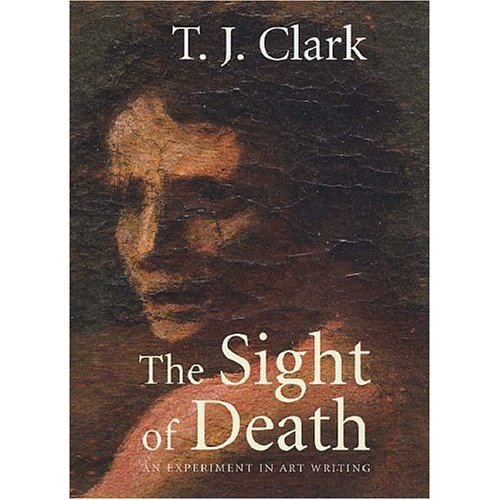
The Sight of Death


Just finished reading T.J. Clark's new experimental book on art writing titled "The Sight of Death" in which he studies two Poussin landscape paintings over an elongated period of time and notes exquisite details about each and enlightens the reader with euphomisms to take home and contemplate on during the train commute home.
Here are some highlights:

"We are living, I reckon, through a terrible moment in the politics of imaging, envisioning, visualizing; and the more a regime of visual flow, displacement, disembodiment, endless available revisability of the image, endless ostensible transparency and multi-dimensionality and sewing together of everything in nets and webs - the more this pseudo-utopia presents itself as the very form of self-knowledge, self-production, self-control - the more necessary it becomes to recapture what imaging can be..."

Clark reiterates the ultimate self-consciousness of art production, of visualization as victim to de-personifying experiences, stripping the private of its intimacy and over-democratizing and making available the single object. This of course due to such magical creations as the internet that allows me to take my self-knowledge into a form of self-production and recapture my experiences through mediums such as blog-writing!

"My art history has always been reactive. its enemies have been the various ways in which visual imagining of the world has been robbed of its true humanity, and conceived of as something less than human, non-human, brilliantly (or dully) mechanical"

Correct me if I'm interpreting him wrong but, I love and cherish T.J. Clark for his anti-formalism, his effort of "making the painting fully part of a world of transactions, interest, disputes, beliefs, "politics"...the sign of art's coming down from its ivory tower". That's exactly what this blog is about isn't it? It's about taking what you see and interpreting it accordingly to the society in which it originates. Its what I sense the art world consists of: the readability of art, the inclusive interpretation, the personalizing and availability of interpretation.

"When I am in front of a picture the thing I most want is to enter the picture's world: it is the possibility of doing so that makes pictures worth look at for me"

What a humbling experience it is to read art by entering it. Art writing and criticism would be so interesting and surreal if it was all about one person's subjective experience upton "entering" a work of art. I love it.

"[The Snake] is the most ambivalent of all things, and its form transfixes and repels. It is the bare fact of causation given a body, or the best figure we are ever likely to have of why things change at all and therefore have a history - why death entered the world, why darkness succeeds light"

This is my favorite section of the book where Clark writes about the snake as not only being phallic but also representative of the vagina as formless and encapturing, "...a body without established hierarchy among its constitutents". I now think how perfect to get a tattoo on my body of a snake in its basket, mysterious and ready to pounce, narcissitic and erotic for its self-touching and manipulating slithery-ness.

So here is my first real blog post. What a nerve wrecking but refreshing experience.

Monday, November 20, 2006

First Step

Having never published an image or published an idea on the ever so democratized internet system I am awed by the sense of authorship I claim upon creating a blog. I've spent the last couple of hours trying to figure how to go about posting photos and viewing and re-viewing my blog page to ease this tension of assimilating to the networld. I've ultimately decided to create a blog to motivate my thought process and produce ample amounts of coherent information for public access. I figure this will help me practice for a future dealing with art criticism and history writing. For months I've been hesitant about writing anything but I wanted ever so badly to write about art: essays, reviews, criticisms, blogs!. and so here I am finally and I do hope I can successfully find my voice and write with confidence about the art world: the art, the artist, the dealer, the collector, the critic, the historian...